.svg "CTA Arrow")


.png "Investor Ready Capital decorative background element")

What Financial Model Tabs Should a Real Estate Sponsor Prepare Before Institutional LP Outreach?
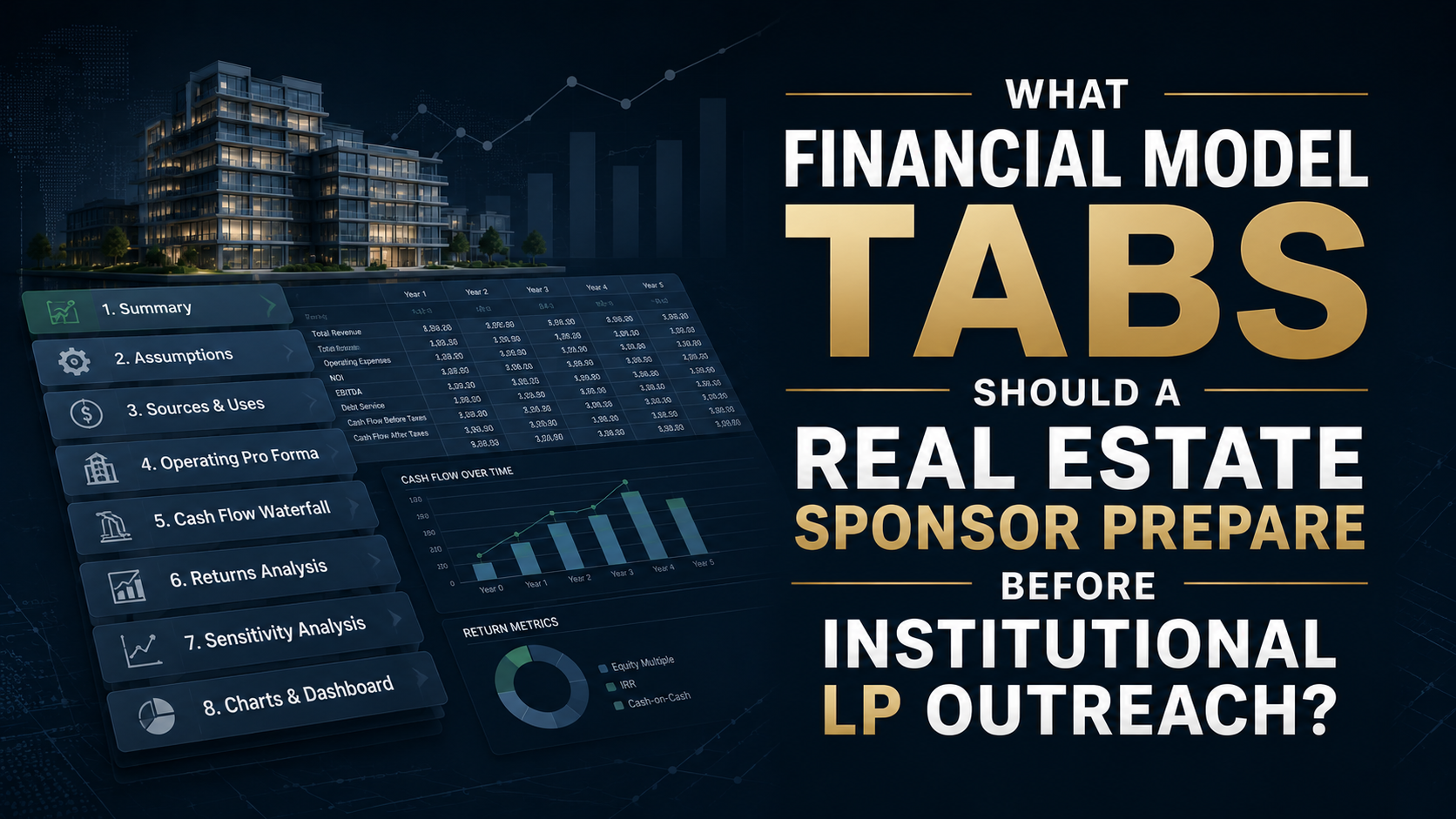
What Financial Model Tabs Should a Real Estate Sponsor Prepare Before Institutional LP Outreach?
A real estate financial model can stall institutional LP interest before an investor tests the underlying deal if returns, assumptions, debt, waterfalls, and downside cases are difficult to find or reconcile. The solution is a model with seven clearly labeled tabs in LP review order: Summary and Returns, Assumptions, Cash Flow, Waterfall, Debt, Capital Stack, and Sensitivities and Scenarios. This structure lets institutional reviewers evaluate the deal's economics, leverage, distribution logic, and downside risk without having to reverse-engineer the workbook.
Institutional LPs navigate models by decision sequence. They open the workbook looking for structure, economics, leverage, and exit logic. A model that buries those answers across unlabeled or inconsistently named worksheets creates friction before a single assumption is tested. That friction is a signal, and it reads as underwriting immaturity.
This article covers the full investor-ready materials package for real estate sponsors preparing for institutional outreach, with a focus on what each tab must show, how tabs should be ordered, and what a missing or incomplete tab communicates to an allocator during first-pass review.
The Minimum Tab Set for an Institutional Real Estate Financial Model
Each tab in the minimum set serves a distinct function during first-pass LP review. Supporting schedules, such as construction draws, capital call timing, and fee income, may sit behind the core tabs. But the seven core tabs must stand on their own. An allocator reviewing the model for the first time should be able to answer the deal's key questions without opening a single supporting schedule.
The comparison below reflects what institutional LPs actually encounter in the field.
A model built for internal analysis often does not translate cleanly to LP review. The tab structure that works for the development team is rarely the structure that reduces friction for an allocator who has not seen the deal before. Restructuring for institutional outreach is a separate step, and sponsors who skip it pay for it in first-pass diligence conversations.
The Summary and Returns Tab: What LPs Check First
The summary tab is the first tab an institutional LP opens and the one that determines whether the model gets a second look. It should consolidate the deal in a single view without requiring the reviewer to navigate elsewhere for basic answers.
A well-built summary tab includes:
- Hold period and business plan description in plain English
- Sources and uses of capital at the project level
- Headline returns: equity multiple, IRR, and cash-on-cash by tranche
- Timing: projected close, construction start, stabilization, and exit
- Exit assumptions: cap rate, sale price, and basis
- Debt summary: loan amount, LTV, rate, and term
- Capital structure overview: LP equity, GP equity, preferred equity if applicable
Labels should use plain English that matches the language in the pitch deck and PPM. Internal shorthand, version numbers, and analyst abbreviations signal that the model has not been prepared for external review.
A strong summary tab lets an LP locate base-case returns and major assumptions in under two minutes. When the summary tab forces the reviewer to hunt for basic numbers, the deal starts its institutional review at a disadvantage before a single site visit or call is scheduled. Sponsors preparing for outreach should treat the summary tab as the model's cover page, because that is exactly how it functions in LP review. Understanding the four checks institutional reviewers run in the first 15 minutes of a model review clarifies why the summary tab either clears that screen or stalls it.
Cash Flow and Waterfall Tabs: How Structure and Economics Must Read
The cash flow tab and the waterfall tab serve different purposes. Keeping them separate is itself a readiness signal.
The cash flow tab shows how money moves through the project period by period. It should cover operating revenue, operating expenses, net operating income, debt service, capital expenditures, and project-level net cash flow. The timing logic must be clear. An LP reading the cash flow tab should be able to identify the construction period, the lease-up or stabilization window, and the hold period without asking a follow-up question.
The waterfall tab translates deal economics into readable distribution rules. It should show the preferred return hurdle, the return of capital sequence, the catch-up provision if applicable, and the LP/GP residual split at each tier. For sponsors working through how to calculate the right GP/LP split for a deal, the waterfall tab is where that calculation becomes visible to the LP.
A weak waterfall tab signals one of two things: the sponsor does not fully control the economics, or the model has not been prepared for external review. Either reading creates friction before a single diligence call is scheduled.
Assumptions, Debt, and Capital Stack Tabs: The Discipline Test
These three tabs are where institutional LPs test underwriting discipline. A model that passes the summary and cash flow review will still stall if the assumptions, debt, and capital stack tabs are incomplete.
The Assumptions Tab
The assumptions tab should centralize every key input in one place. Understanding how a development pro forma relates to the full underwriting package helps clarify why the assumptions tab carries so much weight: it is the audit trail that lets an LP validate every number in the model without asking the sponsor to explain it. It must:
- Label each assumption in plain English, not formula shorthand
- Separate inputs from formulas so reviewers can identify what is hardcoded versus calculated
- Group assumptions by category: revenue, expense, financing, exit, and timing
- Show the source or rationale for market-rate assumptions where applicable
An assumptions tab that mixes inputs and outputs, or uses internal codes as labels, forces the reviewer to reverse-engineer the model logic. That is time they will spend on a different deal.
The Debt Tab
The debt tab should make the leverage profile readable at a glance. It must show loan amount, LTV at close, interest rate and type, amortization schedule, loan term, and DSCR at stabilization. If the deal involves a construction loan converting to permanent financing, that transition should be modeled explicitly with clear timing.
The Capital Stack Tab
The capital stack tab should answer three questions in sequence: who provides each layer of capital, when each layer is drawn, and how the layers interact across the project timeline. Sponsors preparing for institutional outreach should review how capital stack advisory mistakes stall raises before finalizing this tab. A capital stack tab that shows only the final allocation without draw timing or layer interaction gives LPs an incomplete picture of project risk.
Sensitivity and Scenario Tabs: Why They Matter Before Outreach
A single projected return is a claim. A sensitivity table is evidence. Institutional LPs treat these as different categories of information.
The sensitivity tab turns a base-case IRR into a defensible range. It shows how returns move when key assumptions change, and it demonstrates that the sponsor has thought through downside scenarios before presenting to capital. A model without a sensitivity tab tells the LP that the sponsor is presenting one version of the future with no acknowledgment of the variables that could change it.
The variables every institutional sensitivity tab should test: exit cap rate, rent growth rate, vacancy or downtime, expense inflation, construction cost overrun, refinance rate, and hold period length. For guidance on how most CRE deals should be stress-tested across key variables, testing four to six of these in a two-way sensitivity grid is the standard for institutional review.
A scenario tab goes one level deeper. It should distinguish three cases: base, downside, and upside. Each case should reflect a coherent set of assumptions, not just a single variable moved in isolation. The downside case should show whether the deal still returns LP capital and clears the preferred return hurdle under realistic stress.
Sponsors who have reviewed how to stress-test GP/LP economics across scenarios understand that a sensitivity tab also protects GP promote. A model that shows promote erosion under downside conditions is more credible than one that implies the promote is safe regardless of market movement.
{{main-cta}}
How Tab Order and Labeling Affect First-Pass LP Review
Tab order is not a cosmetic preference. It is a navigation system for a reviewer who has never seen the deal before.
The recommended sequence for institutional LP review:
- Summary and Returns
- Assumptions
- Cash Flow
- Waterfall
- Debt
- Capital Stack
- Sensitivities and Scenarios
- Supporting schedules (construction draws, capital call schedule, fee income)
Tab labels should match the language in the pitch deck and PPM exactly. If the pitch deck calls it "Sources and Uses" and the model tab says "S&U v3 FINAL," the mismatch signals that the model and the marketing materials were built separately and never reconciled. That is a process question that becomes a diligence question.
Plain labels. Consistent naming. Review-sequence order. These are the three formatting standards that signal a model built for institutional outreach, not just internal analysis.
What Missing or Weak Tabs Signal to an Allocator
A missing tab is a question the LP cannot answer without asking the sponsor. Every unanswered question adds friction to the review process and increases the chance the deal is passed over before a conversation begins.
Allocators reading a model with missing or incomplete tabs draw specific conclusions:
- A missing waterfall tab suggests the economics have not been finalized or are not LP-ready
- A missing sensitivity tab suggests the sponsor has not stress-tested the deal
- A missing assumptions tab suggests the model was built for internal use and not reviewed for external presentation
- Mislabeled or version-named tabs suggest the model was sent before it was prepared for LP review
The supporting documents that sit behind the model matter too. Sponsors preparing the full document set should review what documents should support a real estate financial model in an investor data room to ensure the model and the data room tell a consistent story. For a complete view of what lenders and LPs require alongside the model, the checklist covering the 47 documents institutional lenders and LPs require before a capital commitment maps the full document set by diligence track.
IRC has served as capital advisor on complex projects including a mixed-use development in Florida with $900M in total capitalization. At that scale, LP-facing model clarity is required before any serious allocator conversation begins. The tab structure is how that clarity is demonstrated before the first call.
If the model exists but the tab structure is incomplete, inconsistent, or formatted for internal use rather than institutional review, restructure it before outreach. IRC works with sponsors to build financial models structured, labeled, and sequenced for institutional LP review from the first conversation.
Book an IRC strategy call to review your financial model tab structure before LP outreach begins.
Frequently Asked Questions
How many tabs should a real estate financial model have for institutional LP outreach?
An institutional-grade real estate financial model should have a minimum of seven core tabs before LP outreach: Summary and Returns, Assumptions, Cash Flow, Waterfall, Debt, Capital Stack, and Sensitivities and Scenarios. Supporting schedules such as construction draws, capital call timing, and fee income may sit behind the core tabs, but the seven core tabs must stand on their own for first-pass review. Models with fewer tabs or tabs that combine multiple functions into a single worksheet create navigation friction that signals the model was built for internal use.
What should the summary tab include in a real estate financial model for institutional LPs?
The summary tab should consolidate hold period, business plan description, sources and uses of capital, headline returns (equity multiple, IRR, and cash-on-cash by tranche), timing milestones, exit assumptions including cap rate and sale price, debt summary, and capital structure overview. All labels should use plain English that matches the pitch deck and PPM exactly. An LP should be able to locate base-case returns and major assumptions in under two minutes without opening any other tab.
What variables should a real estate sensitivity tab test before LP outreach?
A real estate sensitivity tab should test the variables that most directly move project-level returns: exit cap rate, rent growth rate, vacancy or downtime, expense inflation, construction cost overrun, refinance rate, and hold period length. Testing four to six of these variables in a two-way sensitivity grid is the standard for institutional review. The downside case in the scenario tab should show whether the deal still returns LP capital and clears the preferred return hurdle under realistic stress conditions.
What does a missing waterfall tab signal to an institutional LP?
A missing waterfall tab signals that the deal economics have not been finalized or are not ready for LP review. Institutional allocators expect the waterfall tab to show the preferred return hurdle, the return of capital sequence, any catch-up provision, and the LP/GP residual split at each tier. When this tab is absent or embedded inside the cash flow tab without separation, it raises questions about whether the sponsor fully controls the economics or has prepared the model for external presentation.
How should tab labels be formatted in a real estate financial model for institutional review?
Tab labels should use plain English and match the language used in the pitch deck and PPM exactly. Internal shorthand, version numbers such as "v3 FINAL," and analyst abbreviations signal that the model has not been prepared for external review. If the pitch deck calls a section "Sources and Uses" and the model tab uses a different label, the mismatch tells the LP that the model and marketing materials were built separately and never reconciled. Consistent naming across every document in the package is a readiness standard, not a formatting preference.
What is the correct tab order for a real estate financial model reviewed by institutional LPs?
The recommended tab order for institutional LP review mirrors the LP's decision sequence: Summary and Returns first, then Assumptions, Cash Flow, Waterfall, Debt, Capital Stack, Sensitivities and Scenarios, and finally supporting schedules. This order allows an LP to move from deal overview to underwriting inputs to economic structure to stress testing without navigating backward through the workbook. A model organized in a different sequence increases cognitive load and signals that the workbook was built for the analyst, not the allocator.
How does a real estate financial model tab structure affect the 4 to 9 month institutional raise timeline?
Tab structure affects how quickly a model clears first-pass LP review, which is the gateway to diligence and committee presentation. A model with complete, clearly labeled, and properly ordered tabs can move from initial LP review to diligence request within days. A model with missing tabs, inconsistent labeling, or buried economics can stall at first review for weeks, compressing the time available for the diligence and committee stages that follow. Sponsors who restructure their model for institutional review before outreach protect their raise timeline from the first LP conversation forward. IRC Partners works with sponsors to ensure financial models are structured and labeled for institutional review before the first outreach sequence begins.
Continue reading this series:
- What should be included in an investor-ready materials package for a real estate sponsor?
- What materials help institutional investors evaluate a sponsor's capital formation readiness?
- How to calculate the right GP/LP split for your deal
IRC Partners advises operators raising $5M to $250M of institutional capital on structure, positioning, and round architecture. We take seven strategic partners per quarter. No placement agent model. No success-only theater. Capital is raised on the strength of how the deal is built. If you want your current raise reviewed before it reaches the market and silently fails, apply here.
Need guidance on your capital raise?



Real Estate Syndication Companies: How to Evaluate a Sponsor Before You Invest (And What Sponsors Must Prove)

Top Firms for Sovereign Wealth and Pension Capital

Private Credit Lending: How $10M+ Sponsors Use Direct Lending to Fill Capital Stack Gaps Without Giving Up Equity
Disclosure
Nothing on this site constitutes an offer to sell, or a solicitation of an offer to purchase, any security under the Securities Act of 1933, as amended, or any applicable state securities laws. Any offering of securities is made only by means of a formal private placement memorandum or other authorized offering documents delivered to qualified investors.
IRC Partners is a capital advisory firm. IRC Partners is not a registered investment adviser under the Investment Advisers Act of 1940 and does not provide investment advice as defined thereunder.
Certain statements in this article may constitute forward-looking statements, including statements regarding market conditions, capital availability, investor demand, and transaction outcomes. Such statements reflect current assumptions and expectations only. Actual results may differ materially due to market conditions, regulatory developments, company-specific factors, and other variables. IRC Partners makes no representation that any outcome, return, or result described herein will be achieved.
References to prior mandates, transaction volume, network credentials, or capital raised are provided for illustrative purposes only and do not constitute a guarantee or prediction of future results. Past performance is not indicative of future outcomes. Individual results will vary. Network credentials and transaction statistics referenced on this site reflect the aggregate experience of IRC Partners' principals and affiliated advisors and are not a representation of assets managed or transactions closed solely by IRC Partners.
Certain data, statistics, and information presented in this article have been obtained from third-party sources. IRC Partners has not independently verified such information and expressly disclaims responsibility for its accuracy, completeness, or timeliness. Readers should independently verify any third-party data before relying on it.
Readers are strongly encouraged to consult qualified legal, financial, and tax professionals before making any investment, capital raising, or business decision.
Schedule A Meeting
You get one shot to raise the right way. If this raise is worth doing, it’s worth doing with precision, leverage, and control.
This isn’t a practice run. Serious capital. Serious strategy. Let’s raise it right.
We onboard a maximum of seven
new strategic partners each quarter, by application only, to maximize your chances of securing the capital you need.
