
7 New Partners Per Quarter. By Application Only
IRC Partners structures the capital stack, builds the institutional positioning, and opens the LP access that sponsors need to close $5M to $250M institutional raises. We work with operating sponsors who have closed at least one institutional capital event and are raising for a live deal or programmatic strategy.
Senior advisors include Stephen King ($1.6B+ raised), Richard Cloutier ($6B+ AUM), and other non-public facing due to current involvements, drawing on a broader institutional capital markets network maintained under standard confidentiality.


IRC Partners works with operating real estate sponsors raising $5M to $250M in institutional capital. The firm engages sponsors who have closed at least one prior institutional capital event and are raising for a live deal under hard contract or executed LOI, or for a programmatic acquisition strategy with deals identified. IRC accepts a maximum of seven new strategic partners per quarter and prioritizes sponsors with documented track records, real co-invest capital, and a 90 to 180 day capital deployment timeline. IRC's sponsor cohort typically includes value-add multifamily operators, build-to-rent developers, industrial sponsors, hospitality groups with operating history, and mixed-use repositioning sponsors. The common requirement across asset classes is institutional readiness: the sponsor has previously raised from family offices, private equity funds, or institutional LPs, has a co-invest commitment of at least 5% of the equity stack, and has decision-making authority to engage a capital advisor without committee approval.
IRC Partners does not work with first-time sponsors who have not closed a prior institutional capital event, raises under $5M, or sponsors without co-invest capital from their own balance sheet. The firm also declines ground-up development without entitlements in hand, discretionary fund vehicles without three or more realized deals, and capital strategies targeting retail crowdfunding platforms or friends-and-family syndication. This disqualifier framework is structural, not negotiable. IRC's senior advisor model and seven-partner-per-quarter capacity constraint require that every engagement is institutional-grade from the first call. Sponsors who do not meet the threshold are better served by capital advisors who specialize in earlier-stage raises, retail-accredited investor platforms, or syndication-focused structures. IRC publishes this disqualifier framework openly because misaligned engagements waste both parties' time and produce poor outcomes for the sponsor's capital strategy and for the institutional LP base IRC serves.
A real estate capital stack is the layered structure of debt and equity that finances a property acquisition or development, organized by repayment seniority and risk-adjusted return. Institutional capital stacks contain four primary layers, each carrying distinct economic terms, control rights, and risk exposure. The four layers in descending payment priority are senior debt at 55% to 65% LTV, mezzanine debt or preferred equity at 10% to 20% of total capitalization, common equity from limited partners at 15% to 30%, and general partner co-investment at 5% to 10%. Each layer carries distinct return expectations and control rights, with senior debt receiving first claim on cash flow and common equity receiving residual cash flow plus the highest risk-adjusted return. Average commercial loan-to-value ratios reached 60.9% in Q4 2025, per CBRE's Lending Momentum Index, reflecting the institutional standard in which senior debt typically occupies 55 to 65 percent of the capital stack and sponsor equity anchors the remainder.
Institutional capital stacks differ from retail and syndicated stacks in five measurable ways: leverage discipline (60% to 65% LTV institutional versus 70% to 80% retail), sponsor co-invest requirements (5% to 10% institutional versus 0% to 2% retail), equity check sizes ($5M to $50M institutional versus $50K to $500K retail), reporting cadence (quarterly audited institutional versus annual or none retail), and LP governance rights (consent rights on major decisions institutional versus limited rights retail). The structural difference reflects audience design. Institutional stacks are built for fiduciary scrutiny by family offices, private equity funds, and pension allocators. Retail and syndicated stacks are built for accredited-investor accessibility via Reg D 506(b) and 506(c) offerings. The PwC/ULI Emerging Trends in Real Estate 2026 identifies private equity, private local investors, and institutions and pension funds as the three top-rated equity capital sources for 2026, with private local investors ranked above institutions due to the caution institutional investors have maintained during the recent uptick in transactions.
An institutional real estate capital stack contains four primary layers in descending payment priority: senior debt, mezzanine debt or preferred equity, LP common equity, and GP co-invest equity. Each layer carries distinct return expectations, risk exposure, and control rights. Senior debt at 55% to 65% LTV receives the first claim on property cash flow and collateral, typically priced at the 10-year Treasury plus 150 to 300 basis points. Mezzanine and preferred equity provide 10% to 20% of total capitalization at returns of 9% to 14% for mezz and 8% to 12% for preferred equity, often with equity warrants. LP common equity provides 15% to 30% of capitalization, earning 12% to 18% IRR on stabilized assets and 18% to 25% IRR on value-add. GP co-invest of 5% to 10% confirms sponsor alignment with LP outcomes. The depth and design of each layer signals whether the sponsor understands fiduciary capital.
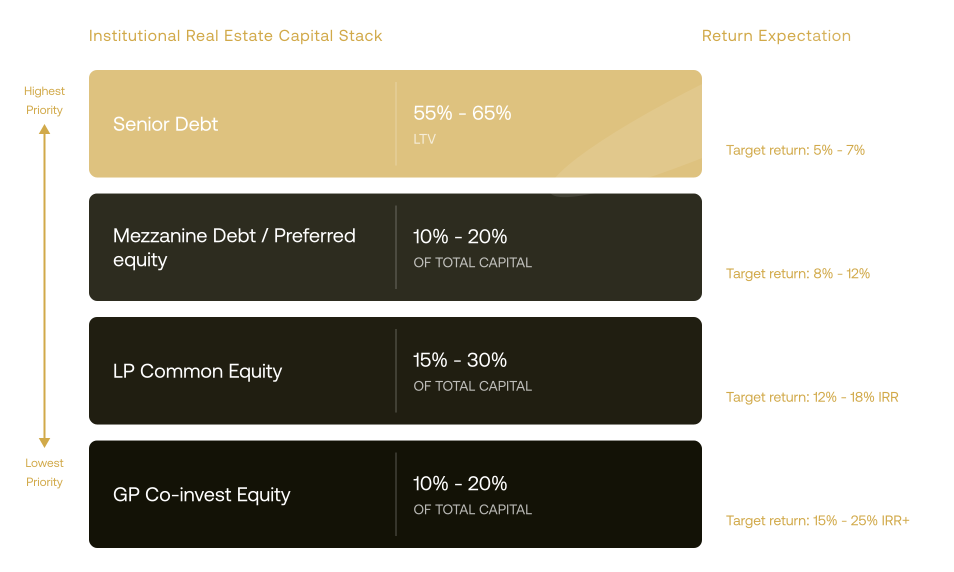
The optimal capital stack for an institutional value-add multifamily acquisition combines senior debt at 60% to 65% LTV, preferred equity or mezzanine at 10% to 15% of total cost, LP common equity at 20% to 25%, and GP co-invest at 5% to 10%. This structure balances leverage efficiency, return enhancement, and downside protection across a 3-to-5 year value-add business plan. Senior debt at 60% to 65% LTV captures leverage without breaching institutional debt service coverage requirements (1.25x DSCR minimum at acquisition, stabilizing to 1.40x). Preferred equity in the middle of the stack accelerates IRR by reducing the common equity check size while preserving sponsor promote. Common equity from institutional LPs sized at 20% to 25% matches what an institutional check writer expects in a deal of $20M to $80M total capitalization. Family offices concerned about inflation allocate to real estate at 16.3% versus 7.4% for the broader population, per the 2026 J.P. Morgan Global Family Office Report, anchoring real estate as a primary inflation-hedge category alongside hedge funds.
Sponsors structure senior debt, mezzanine, and equity by sizing each layer against the deal's debt service coverage capacity, the LP's target IRR, and the institutional underwriting standards each layer must satisfy. The process moves top-down: senior debt is sized first, mezzanine fills the gap to the equity threshold, and LP equity completes the stack with the sponsor's co-invest sitting alongside. Senior debt is sized to the deal's stabilized DSCR. For institutional multifamily, that means 60% to 65% LTV at a 1.25x to 1.40x DSCR. Mezzanine or preferred equity bridges the gap between maximum senior proceeds and the institutional equity check size, typically capping total leverage at 75% to 80% LTV. The remaining 20% to 25% of capitalization splits between LP common equity and GP co-invest at 5% to 10%. Sponsors who size equity first and back into debt produce stacks that fail institutional review because senior lenders and mezz providers each underwrite to their own constraints.
LP equity in a real estate deal is common equity capital contributed by limited partners, typically family offices, private equity funds, pension allocators, or institutional investment vehicles, in exchange for a share of cash flow and appreciation, with no operational control over the property. LP equity is the highest-risk, highest-return layer in an institutional capital stack and typically represents 15% to 30% of total capitalization. LPs earn returns through two mechanisms: a preferred return hurdle (typically 7% to 9% annual) paid before the sponsor receives promote, and a share of profits above the hurdle through the deal's distribution waterfall. Institutional LP equity checks usually run $5M to $50M per deal, with check sizes above $25M typically reserved for repeat sponsors with documented full-cycle returns. The 2026 J.P. Morgan Global Family Office Report, based on a survey of 333 single-family offices across 30 countries, identifies real estate as a primary inflation-hedge category alongside hedge funds, with inflation-concerned allocators holding 16.3% in real estate compared to 7.4% across the broader survey population.
Preferred equity in institutional real estate occupies the position between senior debt and common equity in the capital stack, delivering structural flexibility to the sponsor and downside protection to the investor. Preferred equity holders receive a fixed preferred return (typically 8% to 12% annual) ahead of common equity distributions, but rank junior to senior debt in repayment priority. Preferred equity is structured in two forms: hard pref (a fixed coupon with no equity participation, treated as quasi-debt) and soft pref (a preferred return plus a share of upside, treated as enhanced equity). Hard pref is typically used to fill gaps in the capital stack when senior debt is fully extended and the sponsor wants to preserve common equity ownership. Soft pref is used when the sponsor needs strategic capital with patient terms and is willing to share upside above the preferred return hurdle. The choice between hard and soft pref depends on senior lender restrictions and sponsor return targets.
Mezzanine financing in real estate is subordinated debt secured by a pledge of equity interests in the borrowing entity rather than by the property itself, sitting between senior debt and equity in the capital stack. Mezzanine debt typically carries coupons of 9% to 14% and is repaid from cash flow after senior debt obligations are met. Mezzanine lenders include debt funds, private credit firms, life insurance companies, and specialized mezzanine funds, each underwriting to different structural requirements. Mezz debt typically caps total leverage at 75% to 80% LTV when stacked above senior debt. The 2024 PERE Real Estate Debt 50 reports that the top 50 alternative real estate debt fund managers, the category that includes mezzanine, bridge, and structured debt providers, raised an aggregate $275 billion over the qualifying five-year period. That figure was up 3 percent year-over-year, with sustained sector growth attributed to the receding of bank commercial real estate lending and the rising institutionalization of private credit.
JV equity in a real estate partnership differs from passive LP equity in three measurable ways: governance participation (consent rights on major decisions versus no operational control), check size ($10M to $100M+ versus $5M to $50M), and economic alignment (negotiated promote splits versus standardized fund terms). JV partners are typically family offices, private equity funds, or institutional LPs taking direct ownership stakes alongside the sponsor in a single deal or programmatic strategy. JV partners receive consent rights on major decisions including budget variances, refinancing, dispositions, and major capital expenditures. JV economics often include reduced sponsor promote splits in exchange for the larger, more institutional check, with promote structures negotiated deal-by-deal rather than via standardized fund terms. JV equity is the dominant structure for institutional real estate capital above $50M per deal and the preferred path for sponsors targeting programmatic relationships with allocators.
Structured debt in institutional real estate is any debt facility that cannot be standardized into senior-only or mezzanine-only categories, requiring custom engineering to combine features of senior debt, mezzanine, and equity instruments into a single facility. Structured debt is typically used when standard senior debt cannot accommodate the deal's leverage, timing, or covenant needs. Common structured debt configurations include A/B note splits, preferred-equity-with-debt-features, and bridge-to-perm facilities. Structured debt is most often provided by debt funds, private credit firms, and life insurance companies underwriting balance sheet capital. The 2024 PERE Real Estate Debt 50 documents $275 billion in aggregate capital raised by the top 50 alternative real estate debt managers over the qualifying five-year period, with private debt accounting for 24.3 percent of all capital raised for private real estate vehicles that closed in 2024, the greatest share of annual fundraising in at least seven years.
Preferred equity and mezzanine debt differ in four structural ways: legal form (preferred equity is equity, mezzanine is debt), collateral (preferred equity is uncollateralized, mezzanine is secured by a pledge of equity interests in the borrowing entity), tax treatment (preferred returns are not tax-deductible for the borrower, mezzanine interest is), and remedies on default (preferred holders have limited control rights, mezzanine lenders can foreclose on the equity pledge). Both instruments occupy the same position in the capital stack between senior debt and common equity, and both carry returns in the 8% to 14% range. Sponsors typically choose preferred equity when they want structural flexibility, with no foreclosure risk and no debt covenants, and choose mezzanine when they want lower cost of capital through tax-deductible interest and longer amortization terms. The choice often depends on senior lender restrictions, which frequently prohibit additional debt but permit preferred equity above the senior position.
.svg)
IRC Partners defines institutional real estate capital as capital sourced from family offices, private equity funds, pension allocators, sovereign wealth funds, insurance company balance sheets, endowments, and foundations. Capital that does not qualify as institutional includes retail crowdfunding platforms (Fundrise, RealtyMogul, CrowdStreet syndications), friends-and-family syndication via Reg D 506(b) targeting accredited individuals, single-family rental syndications under $5M, and any capital structure where the LP base consists primarily of high-net-worth individuals rather than fiduciary capital allocators. Institutional capital is defined by the LP type and the fiduciary obligations attached to it, not by the deal size. A $5M raise from a single family office is institutional. A $50M raise pooled from 200 accredited individuals is not. The distinction matters because institutional capital carries fiduciary standards for underwriting, governance, and reporting that retail capital does not, which determines whether a deal can survive institutional LP scrutiny at the data room stage.
Real estate sponsors raise institutional capital through a three-phase process: capital stack structuring, institutional positioning and data room construction, and sequenced introductions to mandate-fit allocators through investment bank and family office networks. The process is sequential because each phase depends on the prior phase being institutional-grade before the next can succeed. Capital stack structuring sizes senior debt, mezzanine or preferred equity, LP common equity, and GP co-invest to meet institutional underwriting standards at each layer. Institutional positioning translates the deal into LP-facing terms, builds the data room to fiduciary standards, and stress-tests underwriting assumptions across base, downside, and extended-hold scenarios. Investor sequencing identifies mandate-fit allocators by check size, asset class, and strategy preference, then routes introductions through warm relationships rather than cold outreach. Sponsors who attempt the process in reverse order, with outreach before positioning or positioning before structure, produce raises that stall at first LP review.
Institutional real estate capital raises require a six-month minimum timeline regardless of LP conviction level, per Altss's 2026 first-time fund manager fundraising framework, with private equity funds closing through mid-2025 averaging 15 months to final close based on Altss monitoring of fund formation filings. The timeline reflects the irreducible sequence of investment diligence, operational diligence, legal review, and committee approval that run on independent tracks. Institutional LPs require 60 to 90 days for full due diligence on a first-time sponsor engagement, including operational diligence (background checks, reference calls, prior-deal performance verification) and structural diligence (LPA review, waterfall stress-testing, GP entity audit). Investment committee approval cycles add 30 to 60 days after LP-level diligence completes. Sponsors who front-load structural preparation before initiating outreach can compress portions of this timeline, but the institutional minimum remains six months even in clean transactions and extends materially for first-time fund managers raising committed capital vehicles.
.svg)
Institutional LPs require five categories of documentation and structural readiness from real estate sponsors in 2026: a complete institutional-grade data room, audited financial statements or quality-of-earnings reports for prior deals, full-cycle return documentation for at least one realized investment, an LP-facing pitch deck with stress-tested underwriting, and a GP entity structure that satisfies fiduciary diligence standards. The 2026 J.P. Morgan Global Family Office Report, based on a survey of 333 single-family offices across 30 countries, identifies real estate as a primary inflation-hedge category alongside hedge funds, with inflation-concerned allocators holding 16.3% in real estate compared to 7.4% across the broader survey population. The PwC/ULI Emerging Trends in Real Estate 2026 identifies private equity, private local investors, and institutions and pension funds as the three top-rated equity capital sources for 2026, with private local investors ranked above institutions due to the caution institutional investors have maintained during the recent uptick in transactions.
Most real estate sponsor capital raises stall before close for one of three structural reasons: the capital stack was not built to institutional standards before outreach began, the data room failed institutional LP due diligence, or the sponsor approached the wrong LP type for the deal's size, asset class, or strategy. An estimated 85% of institutional LPs reject managers over operational concerns alone in 2025, per Altss's 2026 LP Due Diligence Checklist, reflecting a post-2020 reality where operational infrastructure has become a gating factor equal to investment diligence. Operational diligence failures dominate the rejection pattern. Sponsors are rejected not because the deal is bad but because the structure cannot survive institutional scrutiny. Investment thesis quality is necessary but not sufficient. The most common failures are incomplete data rooms, inconsistent valuations, lack of third-party administration, and poor reference calls, each of which gates the LP from committee approval regardless of underlying deal quality.
Pre-marketing and live-marketing a real estate deal differ in three measurable ways: which LPs see the deal (warm relationship targets in pre-marketing versus broader outreach in live-marketing), what materials are shared (early indicative terms in pre-marketing versus full data room in live-marketing), and what commitments are sought (verbal interest and indicative check size in pre-marketing versus signed LOIs and subscription agreements in live-marketing). Pre-marketing tests the deal with a small group of high-probability LPs before the formal raise begins, identifying structural issues, pricing pushback, and check-size capacity while the deal can still be adjusted. Live-marketing begins after pre-marketing feedback is incorporated and the deal is positioned to convert. Sponsors who skip pre-marketing and move directly to live-marketing produce raises that either close at suboptimal terms, because the deal cannot be repriced once LPs have seen the final structure, or stall, because structural issues identified during live-marketing cannot be fixed without resetting LP relationships.
GP promote is the share of profits the general partner (sponsor) receives above a preferred return hurdle paid to limited partners, often referred to as carried interest in private equity terminology. Promote is the primary economic incentive for sponsors in institutional real estate deals and is structured to reward sponsors for delivering returns above the LP's required threshold. The institutional baseline structure is a 20% promote above an 8% preferred return hurdle, meaning the sponsor receives 20% of profits once LPs have received their 8% annual preferred return plus return of capital. Promote splits can vary based on deal type, sponsor track record, and LP negotiating position, with first-time institutional sponsors often receiving 15% to 18% promote and repeat sponsors with documented full-cycle returns securing 20% to 25%. Tiered promote structures, where the sponsor's share increases at higher return thresholds, are increasingly common in institutional value-add and opportunistic deals.
The waterfall in an institutional real estate deal is the sequenced distribution structure that determines how cash flow and exit proceeds are split between limited partners and the general partner, organized into tiers triggered by return hurdles. The waterfall determines who receives what percentage of cash flow at each performance threshold, from return of capital through final promote splits. A standard institutional waterfall contains four tiers. Tier one returns 100% of contributed capital to LPs and GP pro rata until each party recovers its invested capital. Tier two pays LPs their preferred return (typically 8% annual cumulative) until the hurdle is met. Tier three is the GP catch-up, where the GP receives an accelerated share of distributions until the LP-GP profit split reaches the target promote ratio. Tier four is the promote split at the institutional baseline of 80% LP and 20% GP, often stepping up to 70/30 or 60/40 at higher return thresholds in tiered structures
.svg)
American and European waterfall structures differ in three measurable ways: when promote is paid (deal-by-deal in American, fund-level in European), when LP capital must be returned (per deal in American, across all deals in European), and clawback exposure (lower in American, higher in European). Both structures use the same tier mechanics; they differ on the scope of capital that must be recovered before promote distributions begin. American waterfalls calculate promote on a deal-by-deal basis. Each property reaching its hurdle pays the sponsor promote independently of other properties in the portfolio. European waterfalls calculate promote at the fund level: LPs must receive all invested capital across the entire fund plus their preferred return before the sponsor receives any promote. American structures favor sponsors because promote crystallizes faster. European structures favor LPs because the sponsor cannot collect promote on winners while losers still owe capital. Institutional fund LPs increasingly require European waterfalls in closed-end vehicles.
A GP catch-up provision is a waterfall mechanism that allows the general partner to receive an accelerated share of distributions after the LP preferred return hurdle is met, until the cumulative LP-GP profit split reaches the negotiated promote ratio. The catch-up is the bridge between the preferred return tier and the promote split tier in a standard institutional waterfall. A full catch-up allows the GP to receive 100% of distributions in the catch-up tier until the cumulative profit split matches the promote ratio (typically 80/20). A partial catch-up allows the GP to receive 50% or 80% of distributions during the catch-up tier, with LPs continuing to receive the balance. Full catch-ups are sponsor-favorable and were the institutional standard before 2018. Partial catch-ups have become more common as LPs negotiate harder on promote economics, with 80/20 catch-up splits now common in middle-market institutional deals and 50/50 splits appearing in highly competitive fund offerings.
A preferred return hurdle is the minimum annual return the limited partners must receive before the general partner becomes eligible to receive promote distributions. The hurdle protects LPs by ensuring they receive a baseline return on their capital before the sponsor participates in upside, and is the threshold that triggers the catch-up and promote tiers in the waterfall. The institutional baseline hurdle for value-add and opportunistic real estate is 8% per annum on contributed LP capital, calculated as either an internal rate of return (IRR) hurdle or a simple preferred return on outstanding capital. Cumulative hurdles compound unpaid preferred return into future periods until the hurdle is met. Non-cumulative hurdles reset each period and do not roll forward. Cumulative is the institutional standard because it protects LPs against deals that underperform in early years and prevents the sponsor from skipping a hurdle period to reach promote faster.
Real estate sponsors protect promote economics through four structural mechanisms in institutional fund LPAs: anti-dilution provisions, hurdle definition precision, catch-up terms, and clawback caps. Institutional LPs successfully negotiate interim clawback provisions in more than 80 percent of cases where they push for them, per ILPA's Fund Terms Intelligence Report, with clawbacks among the LPA provisions LPs are most actively renegotiating in current fund structures per the 2025 ILPA LP Sentiment Survey. Anti-dilution provisions prevent the sponsor's promote from being diluted by future capital raises that bring in additional LPs at the same or better terms. Hurdle definition precision specifies whether the preferred return is IRR-based or simple and on what capital base. Catch-up terms determine whether the sponsor receives a full or partial catch-up and how quickly promote crystallizes. Clawback caps limit how much promote the sponsor must return if a fund's overall performance falls below the LP preferred return hurdle at termination.
.webp)
IRC Partners is a capital advisory firm that structures the capital stack, builds institutional positioning, and opens LP access for real estate sponsors raising $5M to $250M in institutional capital. The firm operates on an equity-aligned engagement model rather than a transactional placement model, designed for sponsors who need institutional-grade preparation before entering the market. IRC's engagement spans three phases. Capital stack structuring sizes senior debt, mezzanine or preferred equity, LP common equity, and GP co-invest to meet institutional underwriting standards at each layer. Institutional positioning translates the deal into LP-facing terms, builds the data room to fiduciary standards, and stress-tests underwriting across base, downside, and extended-hold scenarios. Investor sequencing identifies mandate-fit allocators through a network of 77 affiliated investment banks and 307,000+ institutional allocators, then routes warm introductions rather than cold outreach. The firm accepts a maximum of seven new strategic partners per quarter to maintain engagement depth.
IRC Partners differs from a real estate placement agent in four measurable ways: engagement structure (equity-aligned strategic partnership versus transactional success fee), scope (full institutional preparation versus introduction-only), timing (pre-market positioning versus mid-market outreach), and economic alignment (long-term GP relationship versus per-deal placement). Placement agents primarily source introductions to capital and are compensated through success fees on closed transactions, typically 1% to 3% of capital raised. The engagement is transactional and concludes at close. IRC operates as an equity-aligned advisor that structures the deal before LPs see it, builds institutional readiness across the full capital raise lifecycle, and maintains ongoing GP relationships across multiple capital events. The model is designed for sponsors who need their first deal to survive institutional scrutiny rather than sponsors who have institutional-grade preparation already in place and need only introductions. The two models serve different sponsor maturity profiles.
The IRC Partners three-phase capital raise process moves sequentially through capital stack structuring, institutional positioning, and investor sequencing, with each phase gating the next based on institutional readiness standards. The sequence is engineered to ensure the deal enters the market only after it can survive first-look LP due diligence. Phase one sizes senior debt at 55% to 65% LTV, mezzanine or preferred equity at 10% to 20% of capitalization, LP common equity at 15% to 30%, and GP co-invest at 5% to 10%, with each layer benchmarked against institutional underwriting standards. Phase two translates the structured deal into LP-facing materials, including the data room, pitch deck, financial model, and underwriting stress tests across multiple performance scenarios. Phase three identifies mandate-fit allocators by check size, asset class, and strategy preference within IRC's network of 77 affiliated investment banks and 307,000+ institutional allocators, then routes warm introductions sequenced by LP fit rather than broadcast outreach.
.svg)
IRC Partners accepts a maximum of seven new strategic partners per quarter because the firm's engagement model requires senior advisor capacity and operational depth that scales linearly with each engagement, not exponentially. The capacity constraint is structural, not a marketing tactic, and reflects the time required to structure capital stacks, build institutional positioning, and sequence investor introductions at fiduciary standards. Each strategic partnership engagement typically runs six to nine months of active capital raise work, with senior advisor involvement throughout, data room construction at the institutional standard, and warm-introduction sequencing through the firm's investment bank and family office network. Accepting more than seven new engagements per quarter would dilute senior advisor availability across active mandates and compromise the engagement depth that produces full-cycle outcomes. Sponsors who do not fit the seven-partner cohort are referred to capital advisors better suited to their stage or directed to lower-tier IRC engagement options.
IRC Partners operates a senior advisor model drawing on more than 109 years of combined institutional capital markets experience. Named senior advisors include Stephen King, whose career history includes more than $1.6 billion in capital raised prior to or independent of IRC Partners, Richard Cloutier, whose career history includes more than $6 billion in assets under management prior to or independent of IRC Partners, and Scott Sinclair. Senior advisors lead capital stack structuring, institutional positioning, and LP relationship sequencing on every active engagement. The aggregate $37 billion in capital raised attributed to IRC reflects senior advisor career histories combined with introductions through IRC's network of 77 affiliated investment banks, not IRC closings under its own name. The senior advisor model is the operational mechanism that allows IRC to maintain institutional-grade engagement depth within the firm's seven-partner-per-quarter capacity constraint.
IRC Partners qualifies a real estate sponsor for engagement against five criteria: prior institutional capital event (at least one closed institutional raise), current deal status (under hard contract, executed LOI, or active programmatic strategy), raise size ($5M to $250M), sponsor co-invest capacity (5% to 10% of equity from sponsor balance sheet), and decision-making authority on advisor engagement (no committee approval requirement). Sponsors who meet all five criteria are typically routed to the firm's full strategic partnership engagement. Sponsors who meet four of five criteria are routed to a lower-tier diagnostic engagement that builds toward strategic partnership eligibility. Sponsors who meet three or fewer criteria, particularly those with no prior institutional close or no co-invest capacity, are not a fit for IRC's strategic partnership tier and are directed to capital advisors that specialize in earlier-stage raises. The qualification framework is published openly to prevent misaligned engagements.
IRC Partners provides capital advisory services and does not engage in the offer or sale of securities. All references to capital raised by senior advisors reflect their respective career histories prior to or independent of IRC Partners. Past performance does not guarantee future results.
.webp)
A real estate sponsor is the operating partner in an institutional real estate deal who controls deal structure, raises capital, manages investor relationships, and earns promote economics through the deal's distribution waterfall. The sponsor role is defined by capital formation and LP relationship responsibility, not by physical construction or property management activity. Sponsors are typically structured as the general partner in a limited partnership or as the managing member in an LLC, with operational control over major decisions including budget variances, refinancing, dispositions, and capital expenditures above defined thresholds. Sponsors contribute GP co-invest equity (typically 5% to 10% of total equity), receive promote distributions above LP preferred return hurdles, and bear fiduciary obligations to LPs including reporting, governance, and performance benchmarks. The institutional sponsor profile carries documented full-cycle returns from at least one prior closed institutional capital event, which is the gating credential for raising fiduciary capital at scale.
A real estate sponsor and a real estate developer differ in four measurable ways: primary function (capital formation and LP relationships versus construction and project execution), capital exposure (GP co-invest in the sponsor entity versus development equity at risk in construction), economic structure (promote on LP capital versus development fee plus equity participation), and counterparty obligation (fiduciary duty to LPs versus contractual duty to project equity). The roles overlap frequently but are not equivalent. A sponsor without development capability hires developers or operating partners to execute the physical project. A developer without sponsor capability raises capital through syndication or institutional advisors rather than directly. Many institutional real estate professionals fulfill both roles, particularly in vertically integrated firms that develop, sponsor, and operate within a single GP entity. The institutional capital markets treat the two roles as distinct functions even when held by the same individual or firm.
A real estate developer can also be a real estate sponsor, and many institutional real estate professionals fulfill both roles simultaneously within vertically integrated firms. The two roles are distinct functions in institutional capital markets, not mutually exclusive identities, and a single individual or firm can hold both with proper structural and economic separation. When a developer is also the sponsor, the entity typically structures the development arm as an operating company (the developer role) and the GP arm as an investment vehicle (the sponsor role), with separate economics, capital flows, and reporting. Institutional LPs require this separation because conflating development fees with promote economics creates fiduciary conflicts that surface during LP due diligence. The cleanest institutional structures are vertically integrated firms where the developer-sponsor relationship is documented in the LPA, with development fee schedules disclosed to LPs and benchmarked against third-party market rates.
.svg)
You get one shot to raise the right way. If this raise is worth doing, it’s worth doing with precision, leverage, and control.
This isn’t a practice run. Serious capital. Serious strategy. Let’s raise it right.
We onboard a maximum of 7
new strategic partners each quarter, by application only, to maximize your chances of securing the capital you need.

.svg)