.svg "CTA Arrow")


.png "Investor Ready Capital decorative background element")

What is capital raising for real estate?
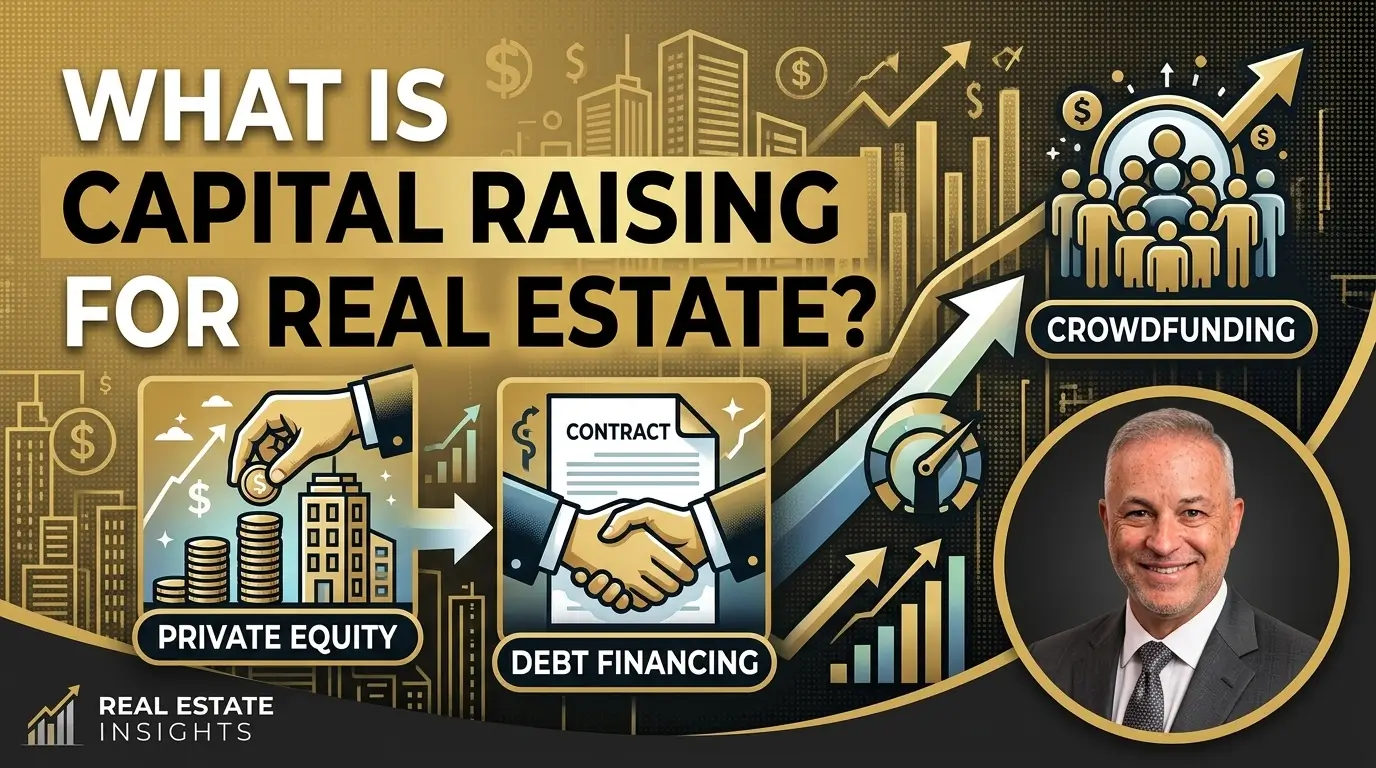
Capital raising for real estate is the process of securing the equity, debt, or hybrid financing needed to acquire, develop, reposition, or recapitalize a property or portfolio. For seasoned developers targeting $10M or more, it is not a broad investor outreach exercise. It is a structured, sequential process of designing an institutional-grade capital stack, preparing materials that survive LP diligence, and matching the deal to capital sources whose check size, risk appetite, and asset class mandate align with what you are actually building.
Key takeaway: Three definitions that matter at the institutional scale:
- Capital raising is the full process of structuring, packaging, and placing the equity and debt that capitalizes a real estate project.
- Institutional capital refers to equity or debt from allocators such as family offices, private equity funds, pension funds, and insurance companies that typically deploy $5M or more per transaction.
- Institutional-grade raise means the deal, the sponsor, and the materials are structured to survive the diligence standards institutional LPs apply before committing capital.
The framing matters. Developers who treat a $10M+ raise as a "find the money" problem consistently underperform those who treat it as a "become the right opportunity" problem. Institutional allocators are not passive. They screen for sponsor pedigree, capital stack logic, downside protection, and reporting discipline before they ever evaluate a pro forma.
According to the Urban Land Institute and PwC's Emerging Trends in Real Estate 2026 report, LPs providing institutional equity typically expect 10-14% returns and contribute 80-95% of the equity in a deal structure. That means the GP's job is not just to find investors. It is to build a deal structure that earns that capital on institutional terms.
This guide covers what capital raising actually means at the $10M-$50M level, how the raise sequence works step by step, why strong projects still get passed over, and what developers can do before the first investor conversation begins. It is the first article in a five-part series covering the mechanics, timing, benefits, common mistakes, and advisor selection for institutional real estate capital raising.
Why Capital Raising Gets Harder Above $10M
A raise below $10M can often be completed through a developer's existing network: high-net-worth individuals, local family connections, and regional lenders who know the sponsor personally. Relationship capital carries the deal. Above $10M, that dynamic shifts completely. The capital sources capable of writing $10M-$50M checks are institutional by nature, and institutional allocators operate on process, not relationships.
The pool of viable capital providers shrinks. The diligence bar rises. And the standards for what a "ready" deal looks like change significantly.
Key insight: The $10M threshold is not just a number. It is the point where you enter a different market with different rules, different players, and a completely different set of requirements for what it means to be "ready."
Private real estate fundraising in the U.S. reached $172 billion in 2025, up 13% from $152 billion in 2024, according to With Intelligence's Real Estate Outlook 2026. That sounds like an open market. It is not. The top 10 funds captured 40% of total capital raised. Nearly 90% of capital flowed into opportunistic, value-add, and debt strategies. The concentration is real, and it means developers entering the institutional market for the first time are competing for a smaller share of a market that is consolidating around established managers.
Understanding how institutional LPs evaluate capital stack structure and risk before you begin outreach is one of the most important steps a developer can take to avoid the months of mismatched diligence that follow when the wrong capital source reviews an unprepared deal.
The good news: two-thirds of institutional investors are currently under-allocated to real estate, according to PERE. Capital is available. The issue is access, and access requires institutional readiness, not just a strong project.
How Capital Raising for Real Estate Actually Works
The institutional raise follows a defined sequence. Developers who skip steps or compress the sequence to accelerate outreach consistently produce worse outcomes: longer timelines, weaker terms, or no close at all. The sequence below reflects how a $10M-$50M raise actually moves from project concept to closed capital.
Step 1: Define the Capitalization Need
Before any materials are prepared, the developer must determine exactly how much capital the project requires, what form it should take, and how each layer of the capital stack supports the deal's risk and return profile.
A typical institutional capital stack for a ground-up or value-add development looks like this:
The goal is to optimize for the lowest weighted average cost of capital while preserving enough GP economics to make the deal worth executing. A stack that over-relies on expensive mezzanine debt or gives away too much preferred equity return can make the project unfundable at the common equity level. Getting the stack right before outreach begins is not optional. It is the foundation everything else is built on.
Step 2: Build the Investment Case and Diligence Package
Institutional LPs do not fund decks. They fund documented opportunities. The investment case for a $10M+ raise includes:
- An institutional-quality pitch deck covering the deal thesis, market analysis, project financials, use of proceeds, and GP track record
- A financial model with conservative base-case assumptions, stress-tested scenarios, and clear return attribution by capital layer
- A data room organized around how institutional LPs actually review a deal: firm and team, track record with audited returns, deal-level financials, legal structure, and compliance documentation
- A track record package that attributes prior project performance specifically to the GP, not the market or a senior partner
Understanding what financial projections institutional LPs expect to see in a pitch deck before building the model ensures the numbers are framed the way LPs actually evaluate them, not just the way developers prefer to present them.
As CBRE's 2026 North America Investor Intentions Survey notes, 55% of institutional investors plan to increase capital allocation to real estate in 2026. But the same survey shows they are concentrating those allocations around sponsors who reduce uncertainty. An incomplete or inconsistent diligence package signals exactly the opposite.
For a deeper breakdown of how to build a data room that moves institutional LPs from first review to signed commitment, see the IRC Partners guide on organizing a data room that closes institutional investors in 30 days.
Step 3: Target the Right Capital Sources
Investor targeting is where most raises fail before they start. The developer identifies the wrong LP type, sends materials to capital sources whose check size or mandate does not match the deal, and burns months in diligence that was never going to close.
Institutional LP targeting requires matching four variables:
- Check size. A family office that writes $2M-$5M checks cannot anchor a $20M equity raise. Most family offices write checks in that range. The subset writing $10M+ checks is smaller than most developers assume.
- Asset class mandate. A PE fund focused on industrial will not flex into multifamily regardless of the return profile.
- Risk appetite. Opportunistic and value-add LPs have different return thresholds and governance expectations than core-plus allocators.
- Geography and market familiarity. Institutional LPs often have defined geographic mandates or preferences.
The choice between a family office and a PE fund as the primary LP is one of the most consequential decisions in the raise. Comparing family offices and PE funds across eight decision factors before outreach begins can save a developer three to six months of misaligned diligence.
For a deeper breakdown of the full mechanics of how each stage of the raise unfolds, the IRC Partners YouTube channel covers the institutional raise sequence in detail.
Step 4: Negotiate Terms and Close
The final stage covers term negotiation, legal documentation, and closing. The key risk at this stage is giving away GP economics that did not need to be surrendered. Developers under capital pressure often accept waterfall structures, promote clawbacks, or governance provisions that reduce GP returns over the life of the deal.
Institutional LPs expect structured governance. They do not expect to own the deal. Knowing where the negotiation lines are, and having an advisor who has seen those terms across multiple raises, is the difference between closing on acceptable terms and closing with regret.
What Institutional Investors Are Actually Looking for in 2026
Institutional capital is returning to real estate in 2026, but it is not returning indiscriminately. CBRE's 2026 North America Investor Intentions Survey found that 55% of institutional investors plan to increase real estate allocations this year. McKinsey's Global Private Markets Report 2026 found that two-thirds of institutions remain under-allocated to real estate, creating structural deployment pressure. The same report notes that asset selection drove approximately 70% of performance differentials in 2025, meaning LPs are concentrating on managers who demonstrate execution discipline, not just deal flow. That is the opportunity.
The constraint is selectivity. Allocators are concentrating capital around sponsors who reduce execution uncertainty, not around deals with the highest projected IRR.
"Successful capital raising now depends more on operational discipline and track record than financial engineering or novelty." — Survey of 173 institutional investors, IREI
What Allocators Screen For Before Investment Committee
Institutional LPs run a parallel process: investment due diligence (IDD) on the deal and operational due diligence (ODD) on the manager. Both must pass independently. A strong deal with a weak management infrastructure does not close.
The screening criteria institutional LPs apply in 2026:
- Audited track record with clear attribution. LPs want to see that prior returns came from the GP's decisions, not market tailwinds. ULI and PwC's Emerging Trends 2026 notes directly: "First-time sponsors rarely succeed; LPs demand audited historical IRRs, successful exits, and institutional-grade reporting."
- Conservative base-case underwriting. Aggressive projections signal inexperience or desperation. Institutional LPs run their own models and discount optimistic assumptions.
- Capital stack logic that protects the LP. Allocators evaluate whether the stack is designed to give them downside protection, not just upside exposure.
- Reporting and governance infrastructure. Quarterly reporting, defined capital call mechanics, and a clear LP agreement are table stakes. Developers who have not operated with institutional-grade reporting before will feel the friction immediately.
- GP co-investment. Meaningful skin in the game signals alignment. Most institutional LPs want to see the GP commit 2-10% of the equity raise in cash, not deferred fees or promoted interest.
- Exit strategy clarity. A credible exit path within the LP's expected hold window is not optional. Open-ended timelines or market-dependent exits create friction at investment committee.
Sector Preferences Shaping 2026 Allocations
CBRE notes that institutional investors are concentrating in operational real estate sectors where income levels and growth drive returns. The strongest institutional LP demand in 2026 is in:
- Multifamily ground-up and value-add (broadest interest across both family offices and PE funds)
- Industrial and logistics (high conviction across LP types)
- Data centers (fastest-growing allocation category, primarily PE and institutional family offices)
- Mixed-use with residential component (strong family office interest)
Developers in these asset classes have a structural advantage. Developers in less-favored categories face a higher bar to demonstrate demand fundamentals and exit liquidity.
The practical implication: sector fit is a screening variable before the deal is even reviewed. Targeting the right LP for the right asset class is not a soft preference. It is a hard prerequisite for getting to investment committee.
Why Developers Fail to Raise Institutional Equity Even When the Project Is Good
A strong site, a compelling market, and a realistic pro forma are necessary. They are not sufficient. The most common reason $10M+ raises fail is not deal quality. It is sponsor-side structural and preparation failures that institutional LPs identify within the first 30 minutes of review.
According to IRC's retainer model analysis, 85% of institutional LP rejections are tied to operational due diligence failures, not investment thesis weaknesses. The data room is incomplete. The capital stack does not hold up under scrutiny. The waterfall mechanics give away too much GP economics. The sponsor went to market before the raise was ready.
Six Failure Patterns That Kill Institutional Raises
- Mis-targeted investor outreach. Sending a $25M equity raise to family offices that write $1M-$3M checks wastes months and burns relationships. The developer looks uninformed. The LP declines and does not re-engage.
- Capital stack designed for a smaller raise. Stacks built for HNWI syndications often have the wrong layer ratios, informal governance terms, and waterfall structures that institutional LPs will not accept. Bringing a retail-grade stack to an institutional LP is a fast path to rejection.
- Unrealistic underwriting assumptions. Institutional LPs run their own models. A base case that requires above-market rent growth, compressed cap rates at exit, or construction timelines that ignore typical delays will be discounted or rejected outright.
- Presenting the raise too early. Going to market before the track record, materials, and governance story are institutionally coherent accelerates exposure to LP rejection. Every investor who passes during diligence is harder to re-approach. There is no second first impression.
- Incomplete or inconsistent diligence materials. Mismatched numbers between the pitch deck, financial model, and data room are the single most common reason institutional reviewers pause a process. It signals that the sponsor does not have a single source of truth.
- Over-negotiating headline economics. Developers who fight hard on promoted interest or GP return thresholds while ignoring governance provisions, reporting requirements, and LP consent rights often close with terms that are more restrictive than if they had negotiated the full package with an advisor.
Understanding how IRC's advisory model sequences structure before outreach explains why the order of operations matters more than the quality of the pitch.
The part most coverage misses: developers who fail institutional raises rarely lose on the deal. They lose on the raise. The project may be exactly what the LP wants. But if the sponsor cannot demonstrate institutional readiness, the LP moves to the next deal. Institutional capital does not wait for developers to get ready.
What Institutional-Grade Capital Advising Actually Changes
The difference between a developer who closes a $10M+ institutional raise and one who spends 18 months in failed diligence cycles is rarely the project. It is the architecture of the raise.
Anonymized IRC engagement: IRC Partners worked with a seasoned developer on a mixed-use development in Florida with a total capitalization exceeding $900M. The project had strong fundamentals: established market, experienced operator, and clear demand drivers. What it lacked was an institutional-grade capital stack and a materials package that could survive the diligence standards of the family offices and institutional LPs capable of writing the check sizes the deal required. IRC's engagement began before any LP outreach. The work covered capital stack design, waterfall mechanics, LP-facing term alignment, and diligence preparation. The raise sequence was structured around the institutional allocator landscape, not the developer's existing network. The result was a raise that moved through institutional diligence with a coherent, consistent package rather than stalling on documentation gaps or structural questions.
The advisory role in an institutional raise is architecture, not access. A developer with a strong project but a retail-grade raise structure needs the structure rebuilt before the first LP call. An advisor who leads with outreach before fixing the structure is accelerating exposure to rejection, not increasing the probability of close.
IRC Partners structures the capital stack, waterfall mechanics, and LP-facing terms before the first investor conversation begins. That sequence, structure first then raise, is what separates engagements that reach investment committee from those that stall in preliminary review. The engagement covers all future raises through exit, embedding IRC as a long-term capital partner rather than a transaction-by-transaction broker.
For developers evaluating advisory options, understanding what a capital advisor charges and what that fee actually covers is the right starting point before any engagement conversation.
{{main-cta}}
What Developers Should Do Before Launching a Raise
The biggest mistake developers make is treating outreach as the starting point. It is the last step, not the first. Before any LP conversation begins, the raise must be structurally ready to survive the review it will receive.
A practical pre-outreach checklist for developers preparing a $10M+ institutional raise:
- Pressure-test the capital stack. Does each layer of the stack reflect realistic market terms? Is the weighted average cost of capital supportable given the deal's return profile? Are the waterfall and promote structures aligned with what institutional LPs expect in 2026?
- Audit the track record package. Is prior project performance documented with audited returns and clear GP attribution? Can you answer an LP's DDQ on deal-level IRR, equity multiple, and hold period without referencing a partner or prior firm?
- Complete the diligence package before outreach. Pitch deck, financial model, data room, legal structure, and compliance documentation should all be complete and internally consistent before the first LP receives materials.
- Build a targeted LP list. Identify capital sources whose check size, mandate, geography, and risk appetite match the specific deal. Not a broad list. A curated, matched list.
- Confirm deal-by-deal versus blind pool structure. For most $10M+ raises targeting family offices, deal-by-deal is the right structure. Understanding when deal-by-deal works versus when a blind pool is viable before outreach avoids a fundamental structural mismatch.
The next article in this series covers how capital raising for real estate works step by step, including the full mechanics of each raise phase, how LP conversations are sequenced, and what happens between first contact and signed commitment. Developers who want to understand the timing and sequencing of a $10M+ raise should start there before building an outreach plan.
IRC Partners works with seasoned developers to structure institutional-grade capital stacks, align investor economics, and coordinate introductions to family offices and institutional allocators actively deploying $10M+ in real estate. If your raise is not yet institutionally ready, that is where the engagement begins.
Frequently Asked Questions
What is the minimum track record required to raise $10M+ from institutional LPs?
Institutional LPs typically require a minimum of three completed projects with documented, realized returns and clear GP attribution. For fund-level raises, the bar is higher: five or more exits with audited IRR data, a formal track record package, and a GP commitment of 1-5% of the target fund size in cash. Single-asset deal-by-deal raises have a lower threshold, but the attribution requirement is the same.
How long does a $10M+ institutional real estate raise typically take?
A well-prepared single-asset deal-by-deal raise targeting family offices commonly runs 90-180 days from first LP contact to signed commitment. Fund-level raises take longer, typically 12-24 months across multiple LP relationships. The primary driver of extended timelines is sponsor-side preparation gaps, not investor hesitation. Developers who go to market before the capital stack, materials, and diligence package are complete consistently experience longer cycles.
What materials do institutional investors expect before reviewing a deal?
Institutional LPs expect a pitch deck, a financial model with stress-tested scenarios, a data room with audited track record documentation, a legal structure summary, and a clear use-of-proceeds breakdown. The numbers across all materials must be internally consistent. Mismatched figures between the deck, model, and data room are the single most common reason institutional reviewers pause a process.
How much equity do developers typically contribute in a $10M+ institutional raise?
GP co-investment typically ranges from 2-10% of the equity raise, paid in cash rather than through deferred fees or promoted interest. Institutional LPs view GP cash co-investment as the primary alignment signal. Developers who contribute through fee deferrals or leveraged GP co-invest will face questions about alignment before investment committee.
Is a family office or an institutional LP a better fit for a $10M-$50M development raise?
It depends on the deal structure, timeline, and governance tolerance. Family offices are typically more flexible on deal-by-deal structures and hold period variations. Institutional PE funds offer larger check sizes and faster decision timelines but require formal governance, quarterly reporting, and audited financials. The right LP type depends on four variables: required check size, asset class mandate, risk appetite, and exit timeline.
When should a developer hire a capital advisor for a real estate raise?
The right time to engage a capital advisor is before outreach begins, not after the first LP passes. An advisor's highest-value contribution is pre-market structural work: capital stack design, LP-facing term alignment, and diligence preparation. Engaging an advisor to market a deal that is not yet institutionally ready accelerates exposure to rejection, not the probability of close.
What is the difference between a placement agent and a capital advisor for real estate?
A placement agent is a transactional partner focused on investor introductions and solicitations. A capital advisor provides structural support: refining the capital stack, building the waterfall mechanics, preparing the data room, and aligning LP-facing terms before outreach begins. Capital advisors often work for a combination of retainer and advisory equity, aligning their compensation with the quality of structural work rather than the volume of introductions.
Continue reading this series:
- How does capital raising for real estate work? The institutional raise sequence explained
- When does a real estate developer need to raise institutional capital?
- How emerging real estate fund managers get their first institutional LP anchor commitment
Most founders don't lose the raise because of the pitch. They lose it because the structure was wrong before the first investor call. IRC Partners advises founders raising $5M to $250M of institutional capital. 7 strategic partners per quarter. Start here to schedule a call with our team.
Sponsors weighing this decision should first complete a capital raise readiness assessment for sponsors to confirm the raise is investor-ready.
Need guidance on your capital raise?


What Is a Fund Terms Sheet and What Does It Include for a Real Estate Closed-End Fund?

How to Choose an Advisor for Investor Relations Management
How to Negotiate Investor Reporting Before Signing a $20M Raise
Disclosure
Nothing on this site constitutes an offer to sell, or a solicitation of an offer to purchase, any security under the Securities Act of 1933, as amended, or any applicable state securities laws. Any offering of securities is made only by means of a formal private placement memorandum or other authorized offering documents delivered to qualified investors.
IRC Partners is a capital advisory firm. IRC Partners is not a registered investment adviser under the Investment Advisers Act of 1940 and does not provide investment advice as defined thereunder.
Certain statements in this article may constitute forward-looking statements, including statements regarding market conditions, capital availability, investor demand, and transaction outcomes. Such statements reflect current assumptions and expectations only. Actual results may differ materially due to market conditions, regulatory developments, company-specific factors, and other variables. IRC Partners makes no representation that any outcome, return, or result described herein will be achieved.
References to prior mandates, transaction volume, network credentials, or capital raised are provided for illustrative purposes only and do not constitute a guarantee or prediction of future results. Past performance is not indicative of future outcomes. Individual results will vary. Network credentials and transaction statistics referenced on this site reflect the aggregate experience of IRC Partners' principals and affiliated advisors and are not a representation of assets managed or transactions closed solely by IRC Partners.
Certain data, statistics, and information presented in this article have been obtained from third-party sources. IRC Partners has not independently verified such information and expressly disclaims responsibility for its accuracy, completeness, or timeliness. Readers should independently verify any third-party data before relying on it.
Readers are strongly encouraged to consult qualified legal, financial, and tax professionals before making any investment, capital raising, or business decision.
Schedule A Meeting
You get one shot to raise the right way. If this raise is worth doing, it’s worth doing with precision, leverage, and control.
This isn’t a practice run. Serious capital. Serious strategy. Let’s raise it right.
We onboard a maximum of seven
new strategic partners each quarter, by application only, to maximize your chances of securing the capital you need.
